AI
Automation First, AI Selectively: What That Actually Means in Practice

Interest in automation and AI has risen sharply over the past year. They show up in team conversations, planning sessions, and product roadmaps, often framed as obvious next steps for growing businesses that want to move faster and operate more efficiently.
In many of those conversations, the two ideas are treated as closely related, or even interchangeable. Automation is discussed alongside AI as part of the same push for efficiency, sometimes bundled together under a general sense that work should be “smarter” or more advanced than it was before.
That overlap is understandable. Many modern tools now combine automation and AI features, and the language used to describe them often blurs the line between the two. As a result, it can be difficult to tell where automation ends, where AI begins, and what role each should play in running day-to-day operations.
The problem with that confusion is not theoretical. When automation and AI are treated as the same thing, they tend to be applied in the wrong order, or asked to solve problems they are not suited to handle. The outcome is often systems that feel impressive on the surface, but introduce uncertainty, fragility, or extra oversight behind the scenes. What looks like a technology decision quietly turns into an operational risk.
Understanding the difference, and why the distinction matters, is the first step toward using both in a way that actually makes work easier to run rather than harder to trust.
Automation and AI solve different problems
Automation and AI are often discussed together, but they are fundamentally different in how they behave and what they are good at. Understanding that difference is more useful than understanding any specific tool.
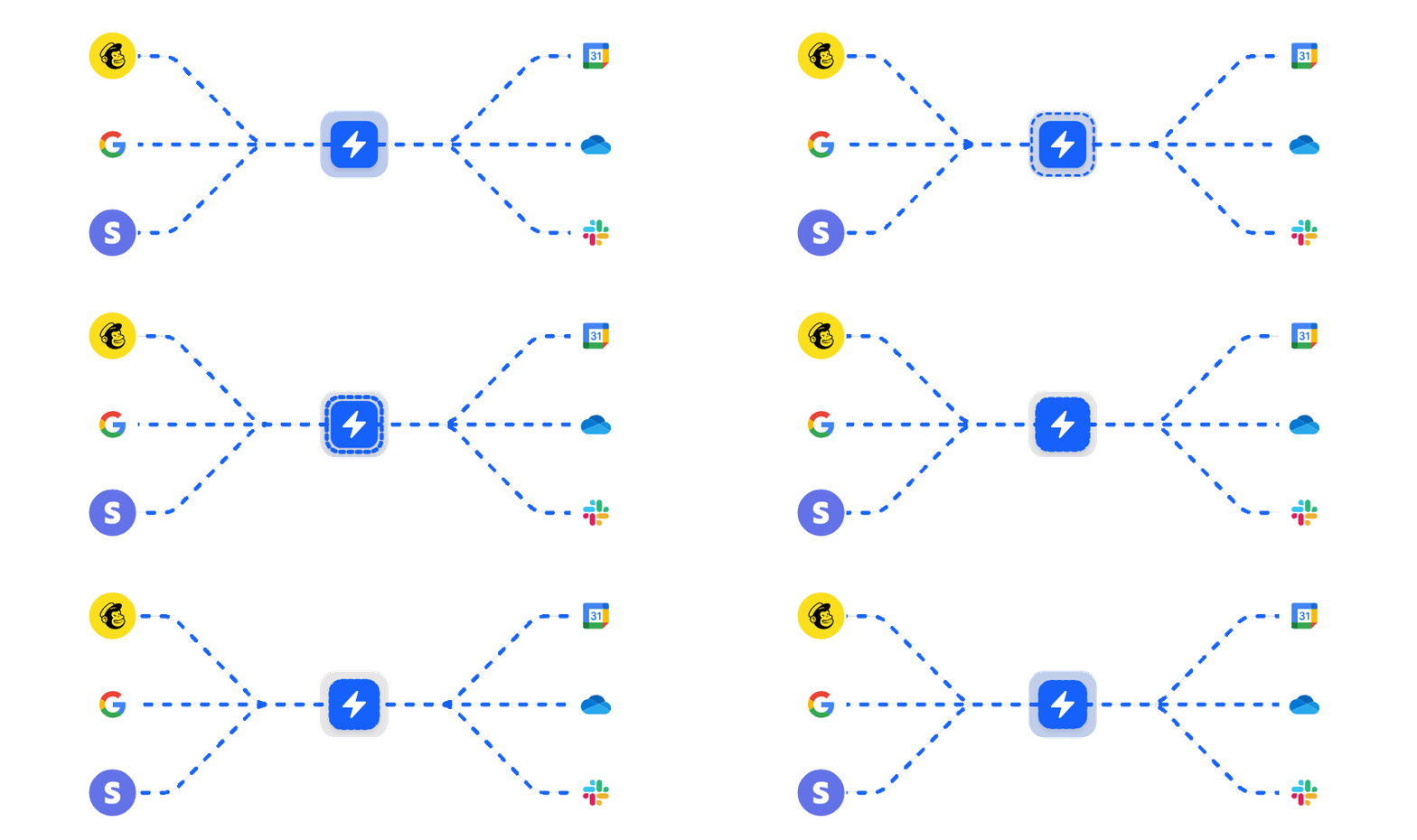
Workflow automation is best thought of as deterministic. Given the same inputs and conditions, it should behave the same way every time. It follows defined rules, moves work from one step to the next, and enforces a sequence that people can rely on. Its strength is consistency. When something is automated well, you know what will happen, when it will happen, and what state the work will be in afterwards.
This predictability is what makes automation suitable for running day-to-day operations. It is good at things like progressing a workflow, synchronising information between systems, enforcing rules, and ensuring that nothing gets skipped. When it fails, it usually fails in visible and diagnosable ways, which makes it possible to fix and improve over time.
AI behaves differently. It is probabilistic rather than deterministic. It interprets information, recognises patterns, and produces outputs based on likelihood rather than certainty. It is especially useful where inputs are messy or ambiguous, such as language, free text, or unstructured data. Instead of following a fixed path, it makes informed guesses.
Because of that, AI is well suited to analysing large volumes of information, summarising content into something more usable, and supporting decisions by highlighting patterns or anomalies that would otherwise take time to spot. In some cases, it can also take limited action, for example drafting responses or routing work, but those actions are most effective when they sit within a clearly defined and reliable workflow rather than replacing it.

The difference matters. Automation is designed to be relied on. AI is designed to assist. Automation moves work forward reliably. AI helps make sense of information so that people can decide what to do next. Confusing the two leads to systems that either try to force certainty where none exists, or introduce uncertainty into places that require consistency.
Seen this way, automation and AI are not competing approaches. They solve different problems and behave in different ways. When each is used for what it is good at, they can complement each other. When their roles are blurred, the system as a whole becomes harder to reason about and harder to trust.
Why the two are often blurred together
Given how differently automation and AI behave, it would be reasonable to expect the distinction to be clear in practice. In reality, it rarely is. One reason is that many products now combine both capabilities in the same place. Automation platforms increasingly include AI features, and AI products often present themselves as ways to automate work. From the outside, it can look like a single category, even though very different things are happening under the hood.
Marketing adds to this blur. To keep messaging simple, categories get collapsed. Automation, AI, integrations, and workflows are often discussed as parts of one broad solution, rather than as distinct layers with different strengths and risks. That simplification makes products easier to explain, but it also hides important trade-offs.
There is also pressure from leadership. As AI becomes more visible, teams feel a need to demonstrate that they are “using AI” in meaningful ways. That pressure can push AI into workflows before the underlying process is clear or stable, simply because it feels like the right direction of travel.
Finally, many success stories focus on outcomes rather than mechanics. They highlight speed, efficiency, or headcount savings, but skip over the operational detail of how those systems were designed, where humans stayed involved, and what had to be stabilised first. Without that context, it is easy to assume that AI itself was the solution, rather than part of a more considered system.
What “automation first” actually means
Saying “automation first” is often misunderstood as being cautious, or as deliberately holding back from using AI. That is not what it means in practice. Automation first is about order, not ideology. It is the decision to stabilise how work moves before enhancing how work is interpreted.
Imagine a growing company handling internal approvals for spend, hiring, and vendor contracts. Requests come in regularly, and while there is a general understanding of what needs approval and from whom, the actual process varies depending on urgency, team, and context. Some approvals happen in email, some in Slack, some in documents, and some verbally. There is no single view of what is pending, approved, or blocked.
As volume increases, delays become common. Requests sit waiting because no one is quite sure who needs to act next. Finance chases updates. Managers follow up manually. People escalate informally when something feels stuck. The work gets done, but only through constant coordination.
An AI-first approach might try to read approval requests, assess urgency, or decide who should approve them next. That can work in isolated cases, but it quickly runs into trouble because the underlying process is inconsistent. What counts as “urgent”? Which approvals are mandatory versus discretionary? What happens if someone is unavailable? The AI ends up making judgement calls the organisation itself hasn’t clearly defined, and people start overriding it to stay in control.
An automation-first approach starts by making the approval workflow explicit and predictable. Every request enters the same system. Required information is standardised. Approval paths are defined based on clear rules such as spend thresholds or department ownership. If an approver doesn’t act within a set time, escalation happens automatically. The system always knows what state a request is in and who is responsible.
Once that structure is in place, AI can add value without introducing risk. It can summarise requests for faster review, flag missing context, or highlight unusual patterns for closer attention. But the workflow itself no longer depends on interpretation. Even if the AI output is imperfect, approvals still move through a clear, reliable process.
That is the difference the order makes. Automation establishes certainty and flow. AI then reduces effort within that structure, instead of being asked to invent the structure itself.
Where AI genuinely earns its place
In a broader sense, AI can be seen across a wide range of functions and industries, from forecasting and optimisation to fraud detection and recommendation systems. Many of those applications have existed quietly for years and sit deep inside specific domains.
But when most businesses talk about AI today, they are usually referring to generative AI. Tools that can read, write, summarise, analyse, classify, and produce human-like output from messy or unstructured inputs. The strongest use cases tend to fall into a few clear categories.
One of the clearest examples is classification and triage. Generative AI is well suited to reading inbound requests, messages, or documents and suggesting how they should be categorised or routed. This works because classification does not need to be perfect to be useful. If a suggestion is occasionally wrong, a person can correct it without the workflow breaking.
A more subtle but valuable role is pattern and anomaly highlighting. In established workflows, generative AI can surface things that look unusual, inconsistent, or worth a second look based on context. The key point is that it flags, rather than acts. It draws attention without taking control.
Another strong use case is summarisation. Many workflows involve long descriptions, threads, or documents that someone has to read just to understand what is happening. Generative AI can compress that material into a short, usable summary, allowing people to grasp context quickly without changing how decisions are made. Judgement still sits with the human, but the effort to get oriented is dramatically reduced.
Across all of these examples, the common thread is that generative AI is reducing reading, scanning, and initial interpretation effort. It shortens the distance between information arriving and a person being able to act on it. Crucially, if the AI output is imperfect, the workflow still holds. Nothing irreversible happens, and nothing becomes ambiguous.
Judgement over novelty
AI is powerful, but it comes with warning labels. Every time it is introduced into a workflow, it changes how decisions are made, how responsibility is distributed, and how much trust people place in the system. Used with care, it can reduce effort and improve focus. Used carelessly, it can quietly introduce uncertainty into places that need to be dependable.
The same is true of automation. At its best, automation is not innovation. It is infrastructure. It does not exist to impress, to signal modernity, or to tick a box on a roadmap. It exists to make work run more smoothly, with less friction, less checking, and fewer points of failure. Its value is measured over time, not at launch.
This is why restraint matters. Not because new capabilities should be avoided, but because they should be introduced with judgement. The aim isn’t to chase technical sophistication for its own sake, but to build systems that people can rely on, understand, and evolve as the business grows.
When automation and AI are applied in the right order, and for the right reasons, their value compounds. Work moves faster with fewer interruptions. Decisions are supported by clearer context. The system takes on more of the background load, freeing people to focus on the work that benefits most from experience and judgement.
The strongest systems don’t draw attention to how advanced they are. They earn trust by working consistently, quietly, and well.